5 Rules I Live By When Raising Roosters on my Farm
When you raise close to a thousand chickens, roosters stop being a background detail and start becoming one of the most important parts of how the entire farm functions. People often ask me how many roosters I keep, and I always pause before answering, because the number only makes sense when it’s paired with intention….
When you raise close to a thousand chickens, roosters stop being a background detail and start becoming one of the most important parts of how the entire farm functions.
People often ask me how many roosters I keep, and I always pause before answering, because the number only makes sense when it’s paired with intention.
On my farm, I keep 32 roosters among roughly 1,000 chickens, and that number has stayed steady for several years now.
It came from mistakes, hard decisions, and moments where the flock clearly told me something was wrong long before I was ready to admit it.
Rule 1: Balance Matters More Than Ratios on Paper
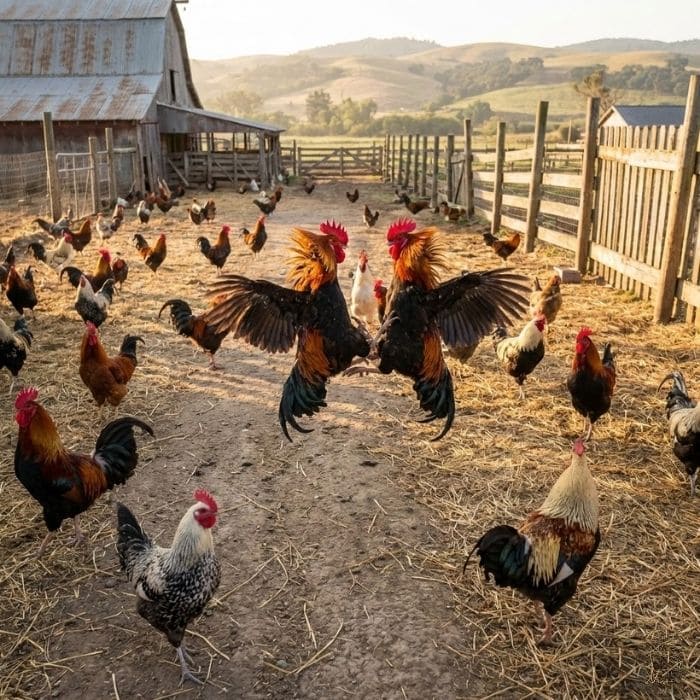
I used to follow the standard advice of one rooster per a certain number of hens and assumed that as long as the math worked, the flock would sort itself out. What I learned quickly is that chickens don’t live on paper, and roosters certainly don’t.
At one point, I kept too many roosters simply because I had raised them from chicks and felt attached. Technically, the ratio still looked acceptable, but behavior on the ground told a different story.
Hens became jumpier, egg production dipped slightly, and minor feather damage started appearing along backs and necks. There were no constant fights, just a steady tension that never seemed to release.
Once I reduced the number of roosters and created clearer territories through fencing and distance, the change was almost immediate. Within two weeks, the flock moved more calmly, laying stabilized, and the yard felt quieter without being silent.
Rule 2: Calm Roosters Protect Better Than Aggressive Ones
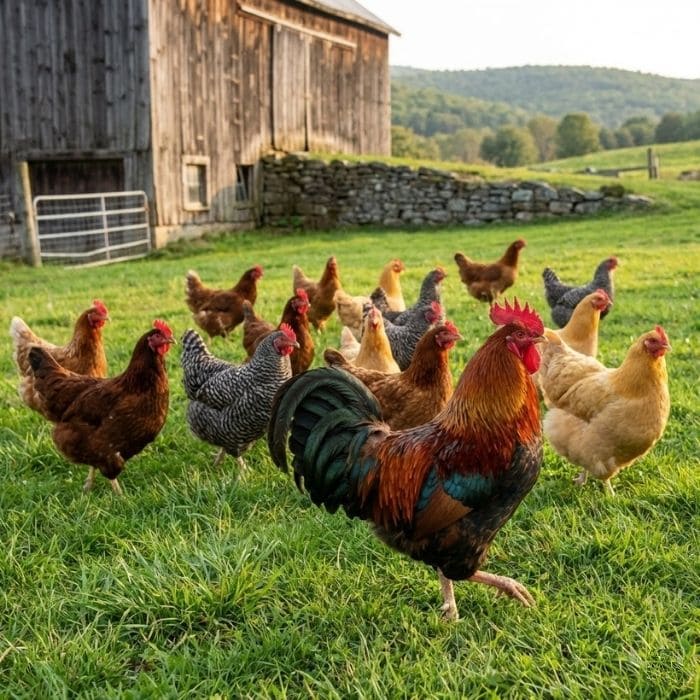
Early on, I kept a rooster who was everything people think they want. He was loud, bold, and fearless, charging anything that moved near the flock.
For a while, I mistook that behavior for strength, until I realized that his constant aggression was exhausting everyone around him, especially the hens.
He over-mated, chased unnecessarily, and never truly settled, which meant the flock never settled either. Eventually, he injured a hen badly enough that I knew I had waited too long to intervene.
Now, the roosters I keep are selected for calm awareness rather than brute boldness. The best ones notice danger without panicking, give clear alarm calls, and position themselves between threat and flock without creating chaos.
I’ve watched these calmer roosters handle hawks, stray dogs, and sudden noises far more effectively than the aggressive ones ever did.
Rule 3: Too Many Roosters Create Stress You May Not See Right Away
Stress doesn’t always announce itself with fighting. On my farm, it often shows up quietly, through changes that are easy to overlook if you aren’t paying close attention.
There was a season when I let the rooster count creep upward because I didn’t want to part with younger males that hadn’t caused obvious problems yet. What followed wasn’t constant conflict, but a subtle shift.
Hens started avoiding certain areas, spending more time hiding in corners of the run. Egg size became inconsistent. Feathers lost their sheen.
When I finally reduced the number by a handful and separated territories more clearly, the flock relaxed almost overnight.
Rule 4: Roosters Must Learn to Live With People, Not Challenge Them
A rooster that doesn’t understand human presence is unpredictable, and unpredictability is dangerous on a farm. I learned this lesson the hard way after being spurred badly by a young rooster who had never been handled or corrected early on.
Since then, I make sure roosters grow up accustomed to my presence. I walk through their space calmly and regularly, correcting posturing early and never allowing charging behavior to go unchecked.
Rule 5: Knowing When to Let Go Is Part of Good Care
This is the rule that took me the longest to accept. Not every rooster is meant to stay in a large flock, no matter how much care you give him.
Some mature into behavior that cannot be safely corrected, and holding onto them out of guilt only leads to injuries, stress, and long-term damage to the flock.
I always keep an exit plan, whether that means rehoming to a smaller setup, separating permanently, or making harder decisions when necessary.
Decisive action, taken early, has saved more birds on my farm than hesitation ever did.