Sweater Chickens in the Pink Coop I Love Most
I raise eighteen Sweater chickens on my farm. I say that number slowly because people usually pause when they hear it, as if waiting for the practical reason to arrive right after. It often does not. Last year, a man visiting my farm looked at them, smiled in a way that was not unkind but…
I raise eighteen Sweater chickens on my farm. I say that number slowly because people usually pause when they hear it, as if waiting for the practical reason to arrive right after. It often does not.
Last year, a man visiting my farm looked at them, smiled in a way that was not unkind but not respectful either, and said, “They are nonsense because these are not for egg production, even chicken. You are so free, haha.”
I stood there, listening, and realizing how familiar that reaction was. People tend to value animals the same way they value land, by output, efficiency, and numbers that can be justified to someone else.
I did not argue with him. I rarely do. But the truth is simple and very clear to me. I keep Sweater chickens because I love them, and because beauty has a place on a farm even when it does not produce something you can sell by the dozen.
Why Sweater Chickens Belong Here
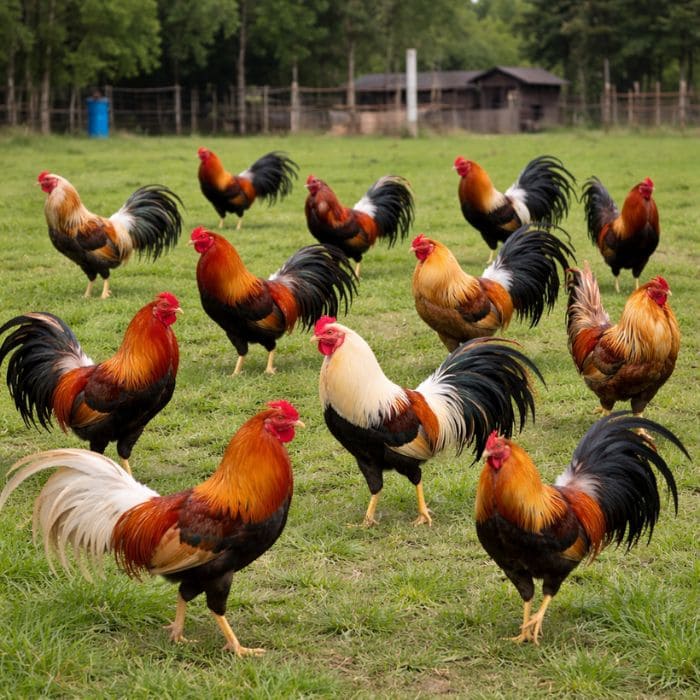
Sweater chickens are unlike any other birds I keep. Their feathers are thick, layered, and soft in a way that looks almost unreal when the light catches them.
They move more slowly than my Leghorns, more deliberately than my Rhode Island Reds. Their presence changes the tone of a space. When they settle, everything feels calmer, as if the air itself has agreed to soften.
Their coats are the first thing people notice. Dense, plush feathers that look closer to wool than plumage, colors that range from muted creams to deeper browns and grays, sometimes even blending together in ways that look hand-dyed rather than natural.
But it is their character that made me keep them. Sweater chickens are observant, reserved, and gentle. They do not rush for feed. They do not challenge the flock hierarchy aggressively and they seem content simply being.
On my farm, peace matters. These birds help maintain it without effort.
A Coop Made Just for Them
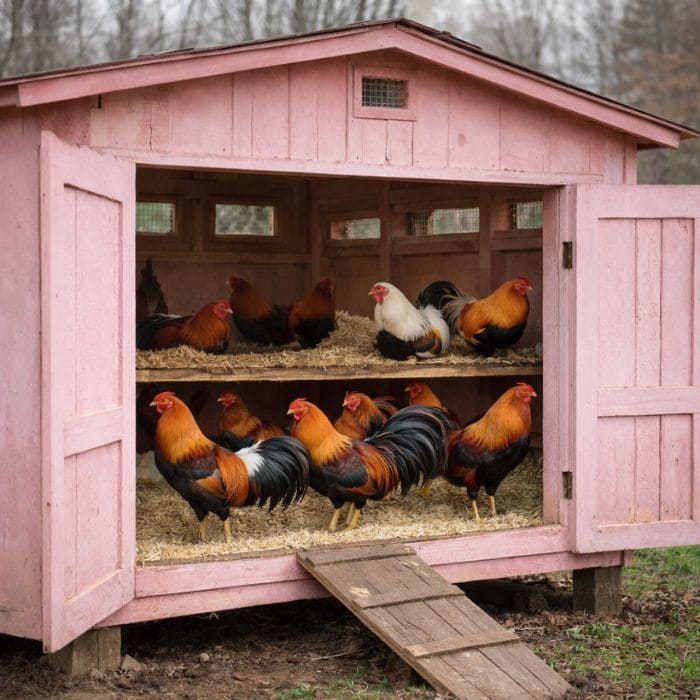
Because of their feathers and temperament, I built a coop just for my Sweater chickens. It sits slightly apart from the others, not isolated, but given space.
I painted it pink, a soft, worn shade that looks almost warm against winter gray and spring green.
Some people laugh at that too, but the color matters to me. It makes the coop easy to spot in low light, and it reflects warmth rather than absorbing cold.
Inside, the roosts are lower and wider to support their bodies. Ventilation is carefully balanced because their thick feathers hold heat differently.
Bedding is always deeper there, and I take more time with cleanliness because dense plumage can trap moisture if neglected.
When the Sweater chickens settle in at night, the coop feels less like housing and more like shelter, which is exactly what I wanted.
Juniper, the One Who Stands Apart
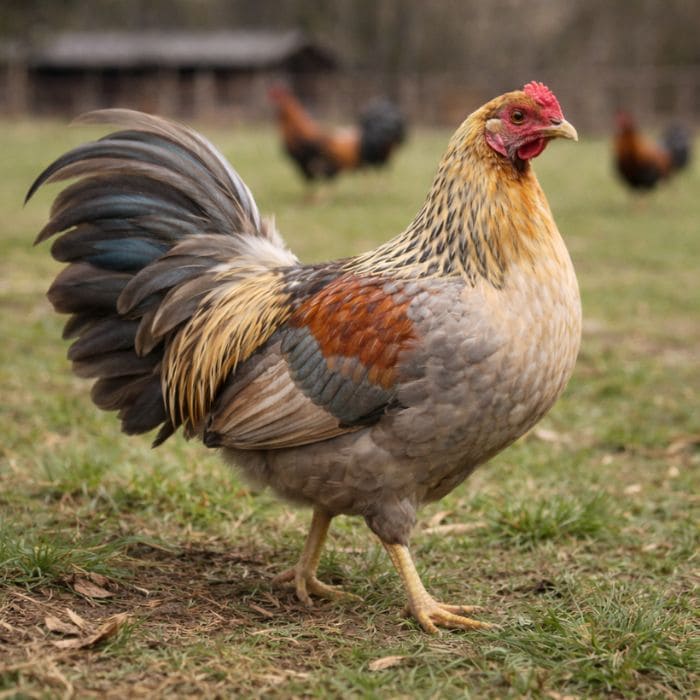
Among the eighteen, there is one hen I have always noticed first. Her name is Juniper. Juniper does not look like the others. While most of the Sweater chickens share similar tones, her feathers carry unexpected color.
Soft gray at the base, then threads of cream, hints of muted rust, and streaks that catch blue in certain light. When she moves, her coat shifts like layered fabric. Her gait is slower than the rest, but intentional, as if every step has already been decided.
Her personality mirrors her appearance. Juniper is not social in the way people expect affection to look like.
She does not seek touch. She tolerates closeness when it is offered quietly. She chooses where she stands and with whom.
Last Winter and the Feathers I Did Not Expect
Last winter was a hard one, colder than usual, with long stretches of stillness that made even experienced keepers uneasy. Juniper went through a heavy molt.
I noticed the feathers gathering in the coop and along the sheltered edges where she liked to rest. At first, I worried. Then I watched closely and saw that she was healthy, simply shedding what she no longer needed.
I began collecting her feathers carefully, never disturbing her, only picking up what she left behind. Over the course of that winter, I realized something extraordinary.
I had gathered more than twenty distinct feather colors from Juniper alone. No two were exactly the same. Some were pale and almost translucent while others were deep, textured, and warm.
I held them in my hands and felt like I was holding a record of time passing.
What I Made From What She Gave
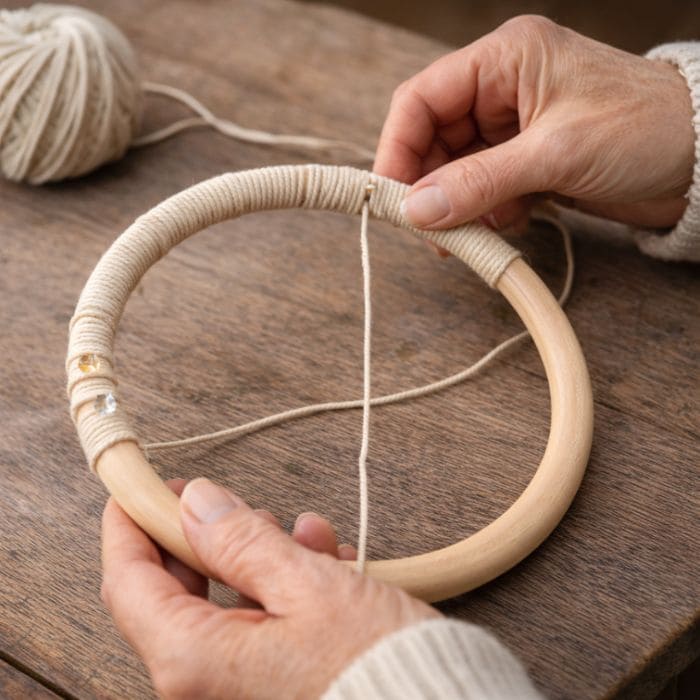
I did not sell Juniper’s feathers, and I did not store them away in a drawer for later. I chose a simple wooden ring, about eight inches across, smooth and unfinished, the kind that still smells faintly of raw wood when you warm it in your hands.
Next, I wrapped it slowly with natural cord, not tight, not decorative, just enough to give it strength.
I added a few small glass beads, clear and pale amber, spaced far apart so they could catch sunlight without turning the piece into something shiny or loud. In the early morning light, those beads glow softly, never stealing attention from what hangs below them.
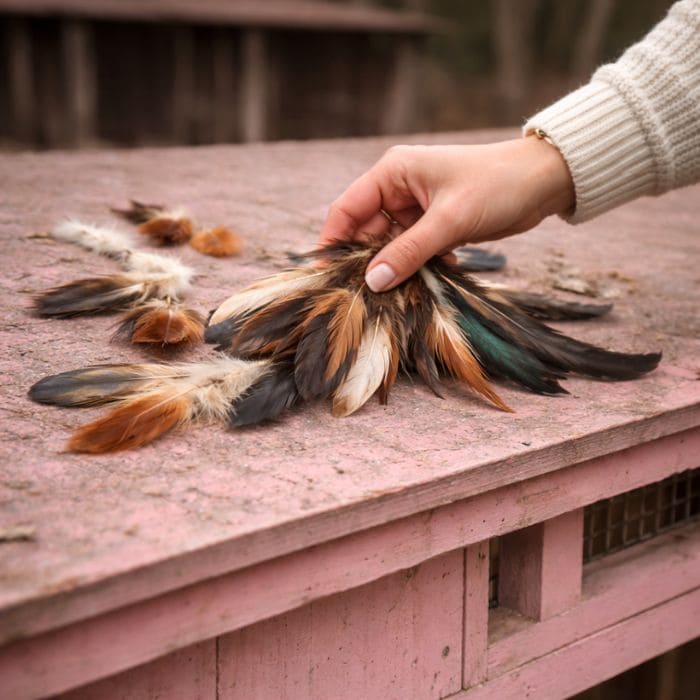
The feathers were the heart of it. I laid them out across my table and realized again how many colors Juniper carried through one winter.
Soft gray, cream, warm rust, faded brown, and tones I still cannot name properly because they change depending on the light.
Some feathers were thin and light as breath, others dense and textured, with sturdy shafts that felt grounding between my fingers.
I worked on it over an entire Sunday afternoon. The kind of afternoon where the house is quiet, the kettle goes cold and is reheated twice, and time loosens its grip.
I tied each feather by hand, adjusting the length so they would move independently, so the wind could speak through them rather than tangle them together.
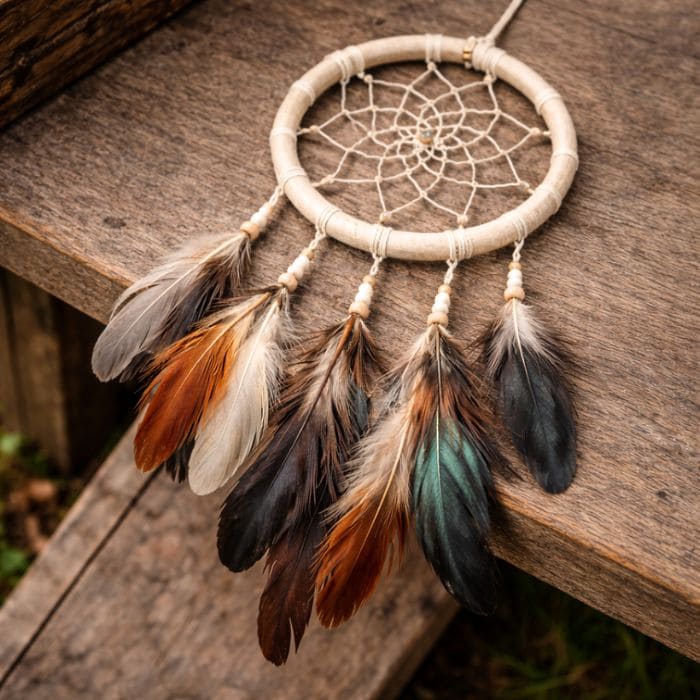
When it was finished, I hung it outside the Sweater chicken coop, just that one coop, where Juniper spends her days.
Every time I see it, I remember that Juniper gave me those feathers without knowing it, and that the best things I make on this farm often come from paying attention long enough to notice what is already being offered.