Why My Chicken Coop Never Smells, Even on Hot Days
When visitors walk through my farm, there is a moment I have learned to recognize. They slow down near the coops, breathe in without realizing it, and then look confused. Some of them ask politely, while others ask bluntly: “Why doesn’t it smell like chickens?” Anyone who has spent time around poultry knows that this…
When visitors walk through my farm, there is a moment I have learned to recognize. They slow down near the coops, breathe in without realizing it, and then look confused.
Some of them ask politely, while others ask bluntly: “Why doesn’t it smell like chickens?”
Anyone who has spent time around poultry knows that this question is not a small one. Chicken odor is one of the biggest reasons people give up raising birds, and it is often what neighbors complain about first.
Strong ammonia, damp rot, sharp waste smell, all of it can turn a good setup into something unbearable.
I did not escape this problem naturally and I learned my way out of it.
Why Chicken Coops Smell in the First Place
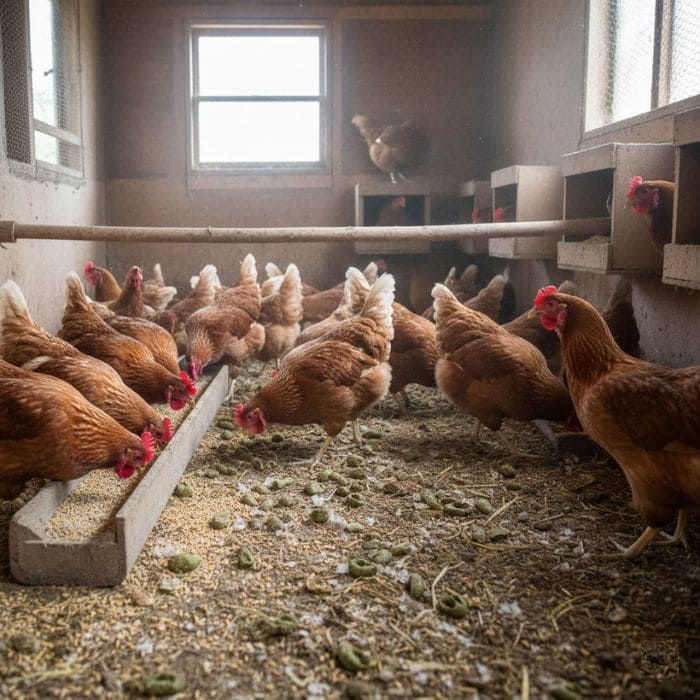
Chicken coops do not smell because of chickens alone. They smell because of concentration, moisture, and poor air handling.
The main culprit is ammonia. Chicken droppings are rich in nitrogen, and when they sit in damp bedding without enough airflow, bacteria begin breaking them down. This process releases ammonia gas, which carries that sharp, eye-watering smell.
Over time, this does more than offend the nose. It irritates chickens’ lungs, weakens their immune systems, stresses them, and makes respiratory illness more likely.
High stocking density makes this worse. So does poor drainage, shallow bedding, and inconsistent cleaning. In hot weather, everything accelerates. Moisture evaporates faster, gas builds up quicker, and smell spreads farther.
When I Faced the Problem Head-On
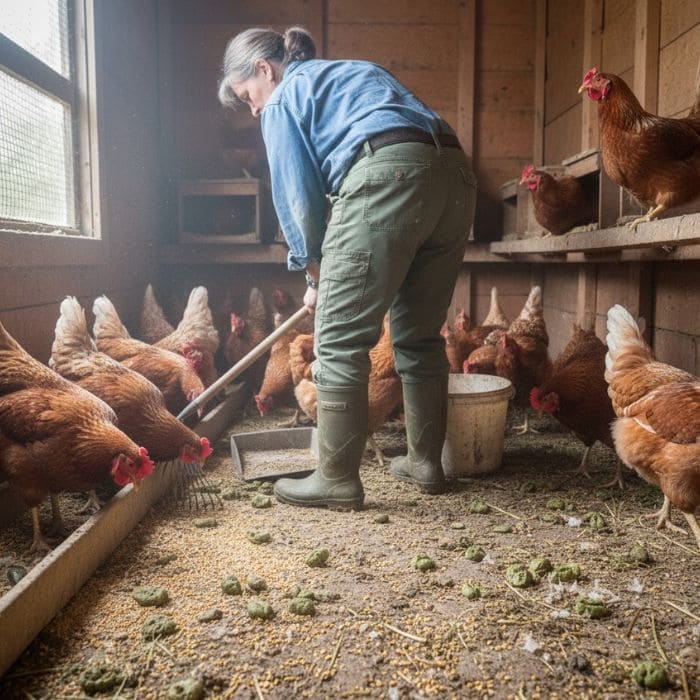
When I was raising chickens at a much larger scale, especially during the years I managed tens of thousands of birds, odor was a constant battle.
No matter how often I cleaned, smell crept back. Wet patches formed under roosts. Ammonia burned my eyes when I stepped inside certain sections. The birds tolerated it better than I did, but I knew it was not right.
Even after I reduced my flock and focused on homestead living, odor still appeared during certain seasons. Heavy rain, high humidity, or sudden heat could undo weeks of careful maintenance.
That was when I started looking for a solution that worked quietly in the background, not something that required daily labor or harsh chemicals.
How I Discovered Activated Charcoal
I did not learn about activated charcoal from farming books. I learned about it the same way I learned about snack patches, by reading late at night and connecting ideas across different fields.
Activated charcoal is widely used for air purification, water filtration, and odor control in enclosed spaces. The more I read, the more it made sense for chicken coops.
Activated charcoal is not the same as regular charcoal. It is processed at very high temperatures to create an enormous internal surface area filled with microscopic pores.
Those pores trap gases, moisture, and odor-causing compounds. It does not mask smell, it absorbs it.
What Activated Charcoal Actually Does in a Coop
Activated charcoal works through adsorption, not absorption. Odor molecules and ammonia gases bind to the surface of the charcoal and stay there instead of circulating in the air.
Because of its porous structure, even a small amount can trap a surprising volume of odor. In a chicken coop, this means:
- Reduced ammonia buildup
- Drier air near problem zones
- Less irritation to chickens’ respiratory systems
- A noticeable drop in sharp, lingering smell
How I Use Activated Charcoal in My Chicken Coops
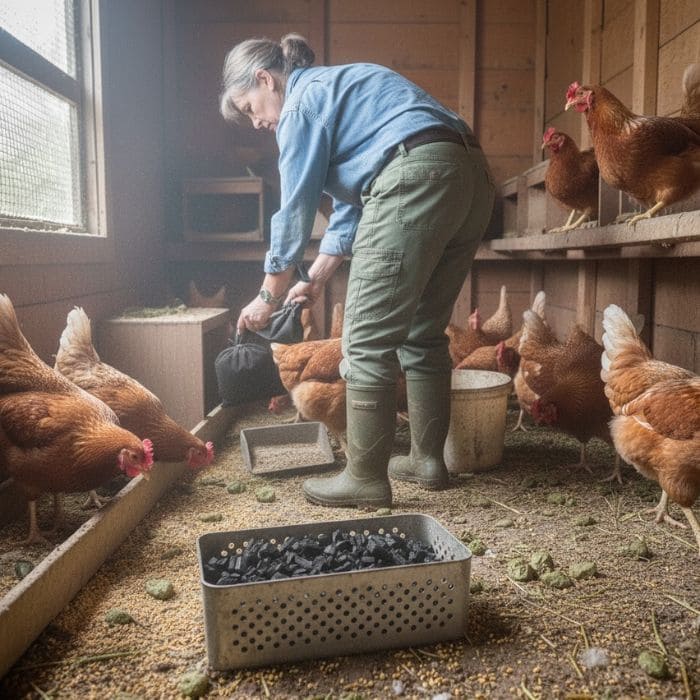
I buy granulated or pellet-style activated charcoal, the kind used for air filtration, not powdered charcoal. Powder creates dust, and dust is the last thing chickens need in enclosed spaces.
I place the charcoal in breathable containers, usually cloth bags or perforated metal boxes. Never loose on the floor, and never where chickens can peck at it.
Each coop gets several charcoal placements, focused on high-risk zones such as under roosting bars, near corners where moisture lingers or close to bedding-heavy areas
For an average coop, I use about one to two kilograms of charcoal, divided across multiple spots rather than one large pile. Distribution works better than concentration.
I replace or recharge the charcoal every few months. Some people bake it in the sun or oven to refresh it, but I prefer replacing it fully to keep performance consistent.
The Difference It Made
The change was not dramatic in the way people expect. There was no sudden freshness or artificial scent. Instead, the sharp edge disappeared.
The air felt neutral. Even on hot days, stepping into the coop no longer caused that instinctive breath-hold.
More importantly, my chickens changed too. Less sneezing, clearer eyes and calmer resting behavior.
What Activated Charcoal Cannot Do Alone
I always say this clearly: charcoal is a support tool, not a solution by itself. Without good hygiene, it will fail.
Here are the habits that still matter most:
- Deep, dry bedding that is turned regularly
- Good ventilation without drafts
- Prompt removal of wet spots under roosts
- Managing moisture after rain and during humid weather
- Not overcrowding the coop
Charcoal helps when these basics are already respected.