Maple Started Eating Her Own Eggs
Maple has always been one of the most dependable hens on my farm. She is a Leghorn with a steady body, clean movements, and a laying rhythm that rarely surprises me. Her eggs are bright-shelled, strong, and regular enough that I often know whether she has laid before I even open the nest box. Gradually,…
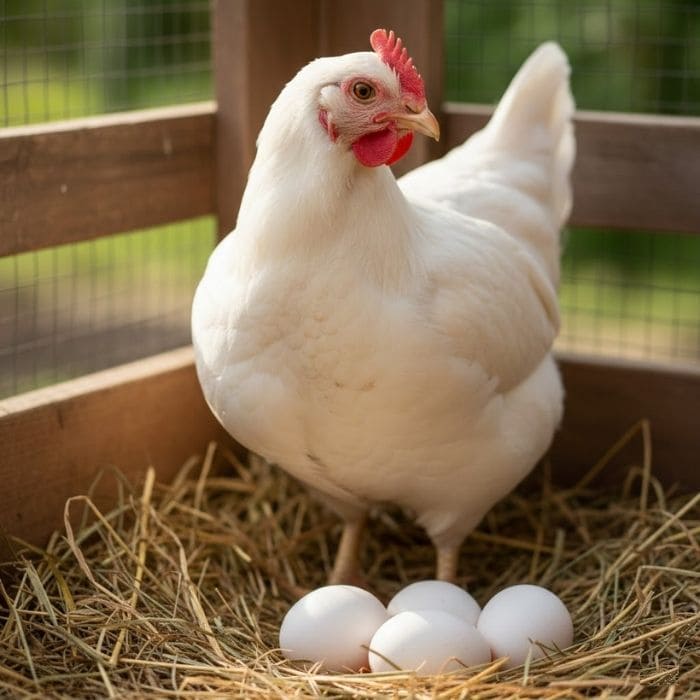
Maple has always been one of the most dependable hens on my farm. She is a Leghorn with a steady body, clean movements, and a laying rhythm that rarely surprises me.
Her eggs are bright-shelled, strong, and regular enough that I often know whether she has laid before I even open the nest box. Gradually, that reliability turns into affection, and affection quietly turns into trust.
That is why what happened two weeks ago unsettled me more than I expected: Maple began eating her own eggs.
Not once, she broke them and consumed them, and when I realized what was happening, I knew immediately that this was not about hunger or nutrition.
The First Night the Hawk Appeared
The chain of events began on an evening that had otherwise felt ordinary. I was doing my final coop check just as the light began to thin and stretch across the yard, when a sudden shadow slid across the ground in front of me.
I looked up and saw a hawk circling low, wings wide and deliberate, feathers layered sharply along its body, moving with a confidence that told me it had already chosen a target.
The bird was large, broader than most I see passing through, with a hooked beak that flashed pale against the darkening sky.
When it cried, the sound was harsh and piercing, the kind that makes your chest tighten before your mind catches up. Its path angled directly toward the Leghorn coop.
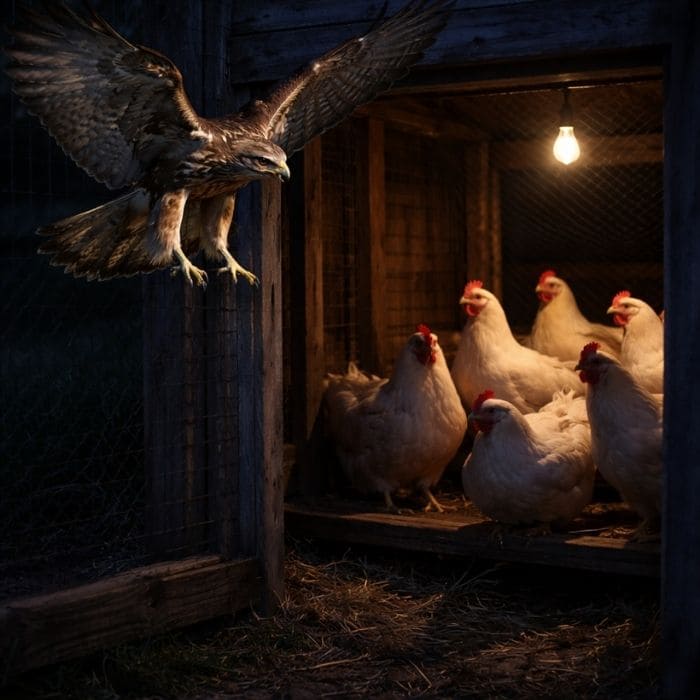
Maple reacted before I fully understood what I was seeing. She let out a sharp, urgent alarm call and moved forward, positioning herself between the flock and the open side of the run. Her wings lifted slightly, not to fly, but to make herself larger, her body tense but rooted in place.
Chickens are not fighters, but they are not helpless either, and Maple held that space long enough for me to react.
I ran, shouted, clapped my hands, grabbed a piece of scrap wood and waved it overhead, doing everything I could to break the hawk’s focus.
At the last second, it veered upward, wings beating hard as it pulled away and disappeared into the trees beyond the field. Everyone survived that night, but Maple did not relax.
The Second Night Cut Deeper
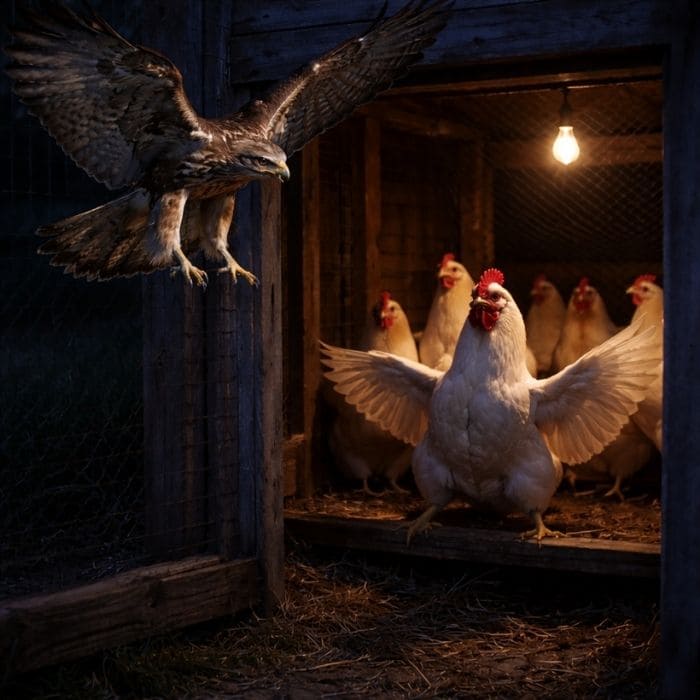
The next night, the hawk returned. This time it came later, when darkness had settled enough to dull visibility but not enough to stop movement.
I heard the panic before I saw it, wings beating close to the coop, birds crying out, the sharp sound of claws striking the fence as the hawk tested boundaries.
It was more aggressive than before, circling lower, screaming, hitting the wire hard enough to rattle it. The intent was clear.
Maple moved again, louder this time, calling continuously, her body angled forward as she placed herself between the rest of the flock and the direction of attack.
I reached the coop at a run, adrenaline high, chasing the hawk away with far less composure than I prefer to admit. Eventually, it retreated, but the damage had already been done.
The Egg That Gave Me False Hope
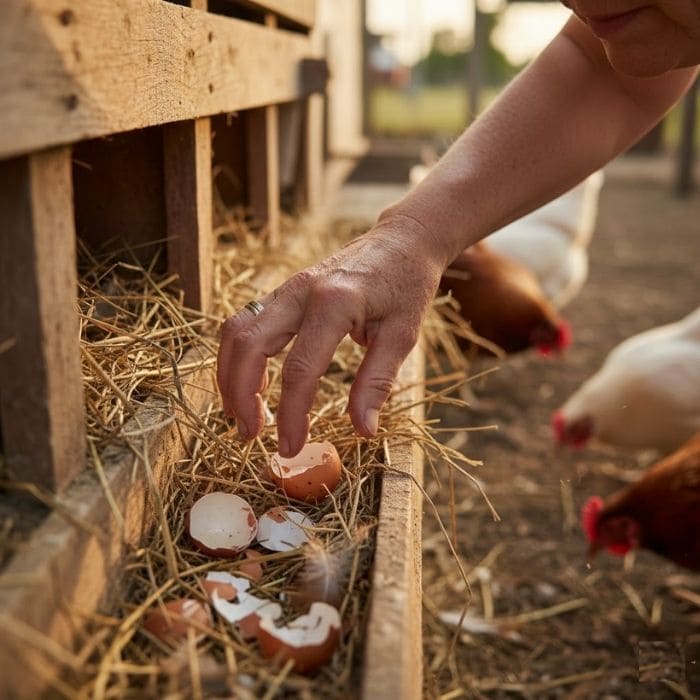
The following morning, I found one of Maple’s eggs intact in the nest. I felt surprised and oddly proud of her, because laying under that level of stress is not easy. I thought perhaps she was already moving past the fear, that her body was settling back into routine.
The next day, there was no egg. The day after that, there was still nothing, but instead I found broken shell fragments pressed into the bedding, sharp edges scattered unevenly across the nest.
At first, I hoped another hen was responsible, but when I looked closer, I saw faint residue on Maple’s beak and knew the truth: she had learned to eat her eggs.
Understanding What Stress Can Do
Egg eating is rarely about hunger, especially in a well-fed flock. In Maple’s case, everything pointed back to those two nights.
Predator stress disrupts hormones, interrupts laying cycles, and leaves hens in a constant state of alertness. When an egg breaks under that pressure, curiosity turns into habit very quickly.
What I Did to Interrupt the Habit
I began by collecting eggs far more frequently, checking nests multiple times a day so there were fewer chances for breakage. I reinforced nesting boxes with softer bedding and made sure they were dimmer, quieter, and more enclosed.
I also tried the method most often recommended for breaking egg-eating behavior, filled eggs. I cleaned empty shells carefully, refilled them with an unpleasant but harmless mixture, sealed them, and returned them to the nest.
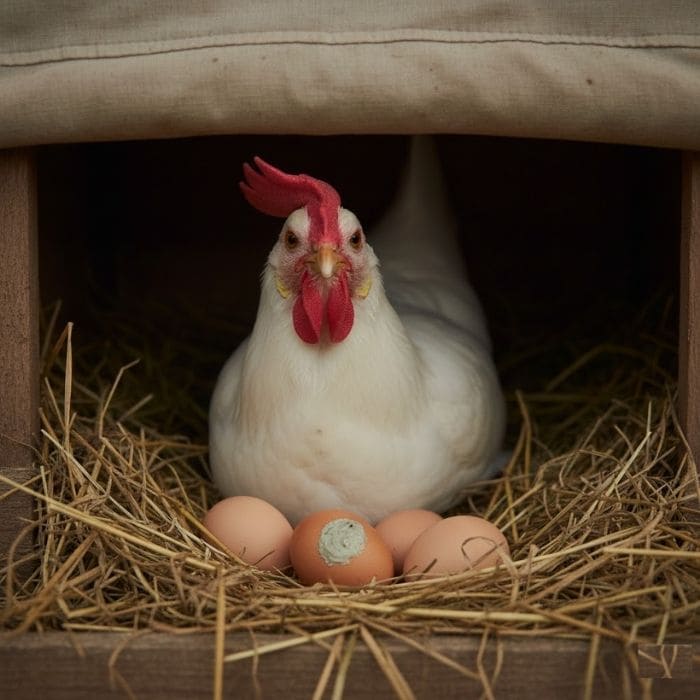
The idea is simple but effective when it works. The hen pecks, expects reward, and instead finds disappointment.
Maple fell for it the first time. She pecked, recoiled slightly, and stepped away. That moment felt like a small victory, but habits formed under stress rarely disappear all at once.
Over the next several days, the behavior reduced, but it didn’t vanish entirely. I still found the occasional shell, smaller fragments, less frequent, but present enough to remind me that fear doesn’t release its grip easily.
Treating the Cause, Not Just the Behavior
It became clear that stopping the habit meant easing Maple’s stress, not just blocking access to eggs. I added additional visual barriers around the coop to reduce sightlines that might trigger alarm, reinforced fencing where the hawk had struck, and adjusted evening routines so the flock settled earlier, with fewer sudden movements and noises.
At night, I began playing very soft, steady music near the coop. Nothing loud or distracting, just a low, consistent sound that masked abrupt noises and helped keep the environment predictable.
Over time, I noticed Maple responding more to that than anything else. Her posture softened and her movements slowed. She spent more time resting instead of scanning the sky.
At this point, I would say the situation is about 70 percent resolved. Maple has resumed laying. Most eggs remain intact. Occasionally, I still find a broken shell, and when I do, I remind myself that recovery after fear is rarely straight or simple.
She was brave when it mattered. She stood her ground when danger came close. What followed was not failure, but fallout.