Do Chickens Get Bored? Yes, and This Is How I Deal With It
Sometimes readers write to me with questions that make me smile, because they are asking exactly the right thing. One email I receive more often than you might expect is this: “Do your chickens ever get bored?” The honest answer is yes, absolutely they do, and anyone who has spent real time watching a flock…
Sometimes readers write to me with questions that make me smile, because they are asking exactly the right thing. One email I receive more often than you might expect is this: “Do your chickens ever get bored?”
The honest answer is yes, absolutely they do, and anyone who has spent real time watching a flock will recognize boredom the moment it appears.
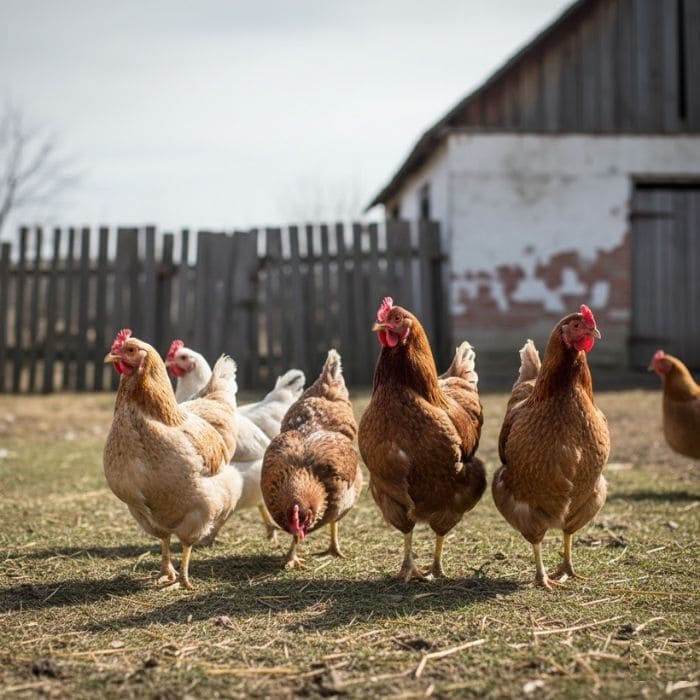
Chickens may look busy all day, but routine without stimulation turns into restlessness surprisingly fast, especially on a farm like mine where nearly a thousand birds share the same familiar spaces every day.
Gradually, I learned that boredom doesn’t show up as silence. It shows up as pecking, pacing, unnecessary squabbles, and that vague unsettled feeling that tells you something is missing. And once I realized that, the solution became simpler than I expected.
Why Chickens Need Stimulation More Than We Think
Chickens are natural foragers. In the wild or in varied environments, they spend hours searching, scratching, chasing movement, and responding to small changes in their surroundings.
On a managed farm, even a good one, life can become predictable. Feed arrives at the same time, water never moves and the ground doesn’t always offer surprises.
I’ve thought of chickens the way I think of children. Give them nothing new to explore, and they will invent problems. Give them something engaging, and the entire atmosphere shifts.
Why I Chose Balls Instead of Treats
At first, I tried breaking boredom with more food. Extra scratch, hanging treats, scattered grains. It worked briefly, but food disappeared, and then boredom returned even faster.
What I needed was movement. That’s when I introduced balls.
Not complicated toys, not expensive farm gadgets, just simple, durable balls that roll unpredictably when pecked or nudged. Movement triggers curiosity, and curiosity turns into play.
The Balls I Use on My Farm
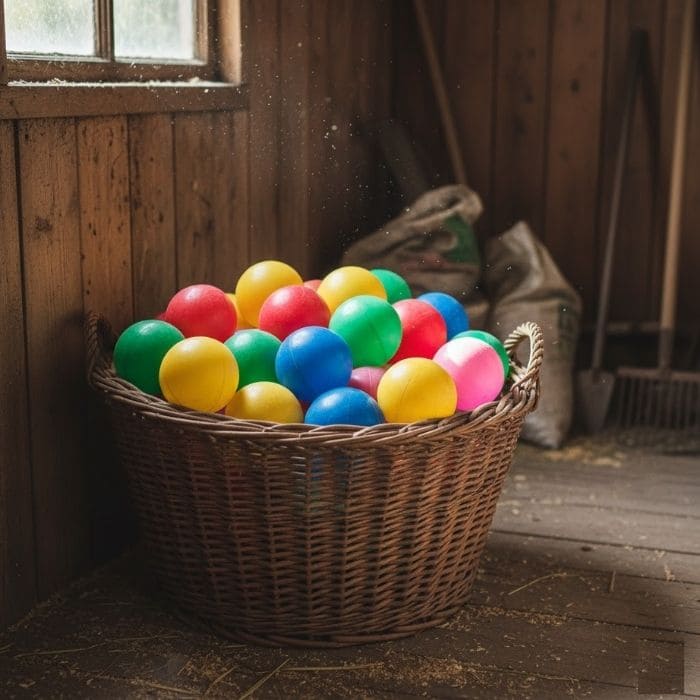
I experimented before settling on what works best. The balls I use now are hard plastic balls, roughly 10-12 centimeters in diameter, about the size of a small orange. They are large enough that chickens cannot swallow or trap them, but small enough to roll easily across dirt and grass.
I choose bright colors, red, yellow, blue, and green, because chickens respond strongly to color. Red attracts attention first, but mixing colors prevents one ball from becoming the center of constant competition.
I avoid soft rubber or foam balls, because curious beaks will destroy them within days. Hard plastic lasts an entire season, sometimes longer.
How I Introduce the Balls
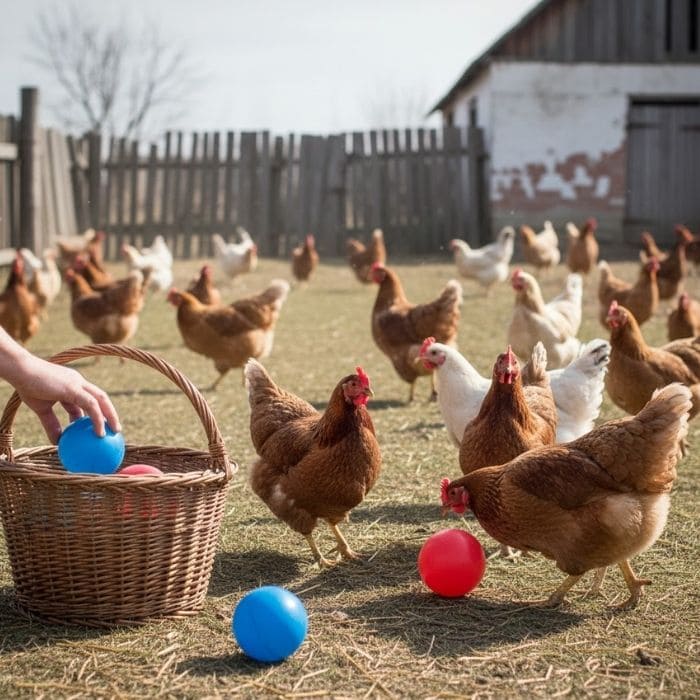
I don’t throw the balls into the yard suddenly, that only startles the flock. Instead, I place two or three balls gently on the ground while the chickens are already active, usually mid-morning after feeding.
At first, they circle cautiously. One hen pecks. The ball moves. Another pecks harder. Within minutes, the yard changes. Chickens chase rolling balls, knock them into each other, steal them, and sometimes simply stand watching as if observing a mystery.
I started small. For a group of fifty chickens, I use two balls. For larger areas, like my Leghorn runs, I add one ball for roughly every 30-40 birds, spaced far enough apart to prevent crowding.
How Often I Let Them Play
I don’t leave the balls out all day, every day. Novelty matters.
On my farm, balls come out three to four times a week, usually for an hour or two at a time. I rotate colors and locations, sometimes placing them near shade, sometimes near open ground, sometimes near the fence line where movement feels different.
That rotation keeps interest high without overwhelming the flock.
What I See When Chickens Play
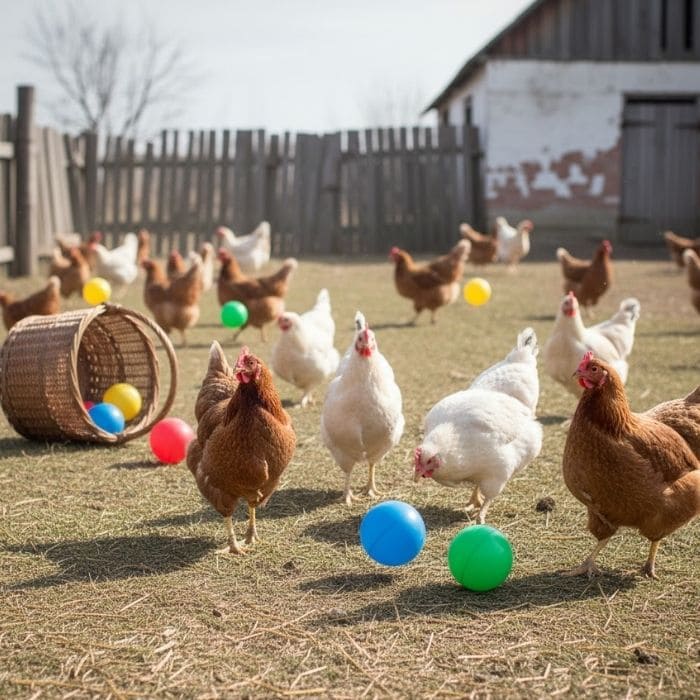
The change is immediate and unmistakable. Birds move more. Pecking shifts from each other to the object.
Lower-ranking hens gain confidence chasing a rolling ball instead of competing for food. Roosters become more alert but less aggressive, redirecting energy into movement rather than dominance.
Juniper, for example, approaches balls thoughtfully, tapping them gently and watching how they roll before committing.
Old Maple prefers chasing once another hen gets the ball moving, stepping in at just the right moment to claim it briefly before letting it go again. Even the quiet birds participate, if only by watching.