Yesterday I Decorated My Chicken Coops for Christmas
Christmas is coming, and this year I wanted it to arrive gently, without pressure, without perfection, and without pretending that my days revolve around my living room. Most of my mornings begin outside, and most of my evenings end there too. Even in winter, when the air bites and daylight shortens, my routines are shaped…
Christmas is coming, and this year I wanted it to arrive gently, without pressure, without perfection, and without pretending that my days revolve around my living room.
Most of my mornings begin outside, and most of my evenings end there too. Even in winter, when the air bites and daylight shortens, my routines are shaped by feathers, footsteps, and familiar sounds.
So instead of decorating my house first this year, instead of pulling out ornaments meant for spaces I only pass through, I decided to decorate my chicken coops.
Starting With the Pink Sweater Chicken Coop
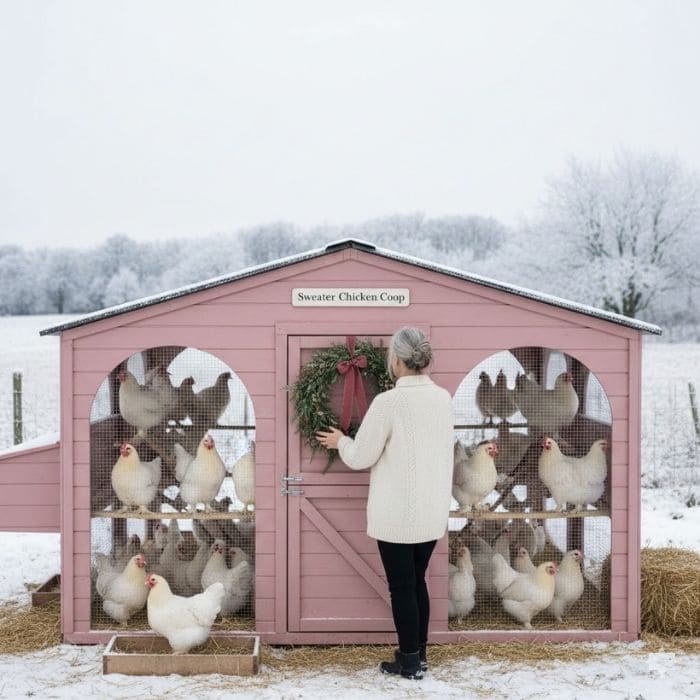
I began with the Sweater chicken coop, because it already carries a softness that feels festive without effort.
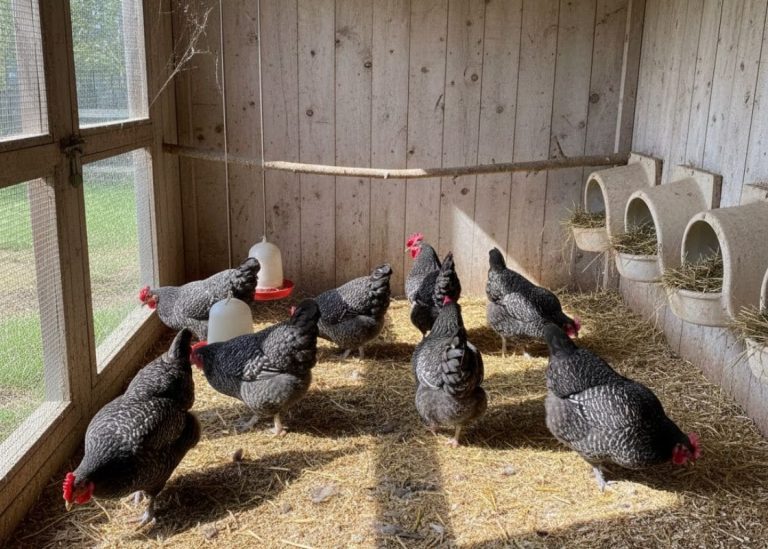
The coop is painted a dusty, gentle pink that stands out beautifully against winter’s muted tones. It houses about 30 to 40 Sweater chickens, and it has always been one of the most peaceful corners of the farm.
The structure itself is compact and welcoming, roughly 3 meters long and 2 meters wide, with a slightly sloped roof and wide openings that let in light while keeping drafts away.
After feeding the chickens in the morning and giving them time to settle into their midday calm, I brought out the decorations.
I kept everything simple and natural. I hung a wreath on the coop door, made from dried branches and evergreen clippings I gathered myself, tied together with a faded red ribbon that didn’t shine or demand attention. The wreath smelled faintly of pine and winter, and it felt right against the pink wood.
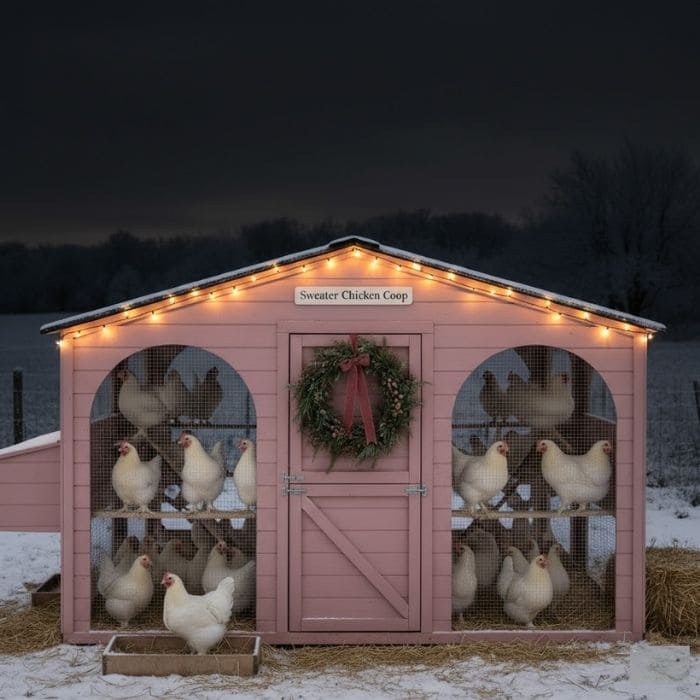
Along the roofline, I added a short strand of warm white solar lights, soft rather than bright, secured carefully so nothing could move or fall. I didn’t decorate the inside at all. The chickens don’t need that, and I didn’t want to disrupt their space. The outside was enough to change the feeling.
By noon, the Sweater coop looked like it belonged in a quiet winter story. Pink walls softened by greenery, gentle light catching the edges, and chickens moving in and out without concern.
Facing the Challenge of the Leghorn Coop
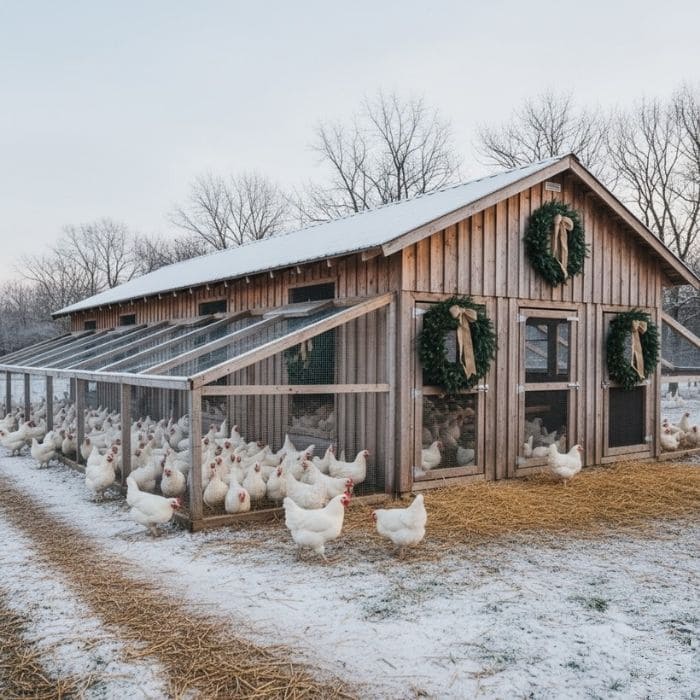
After lunch, I turned toward the Leghorn coop, and immediately I knew this would be different.
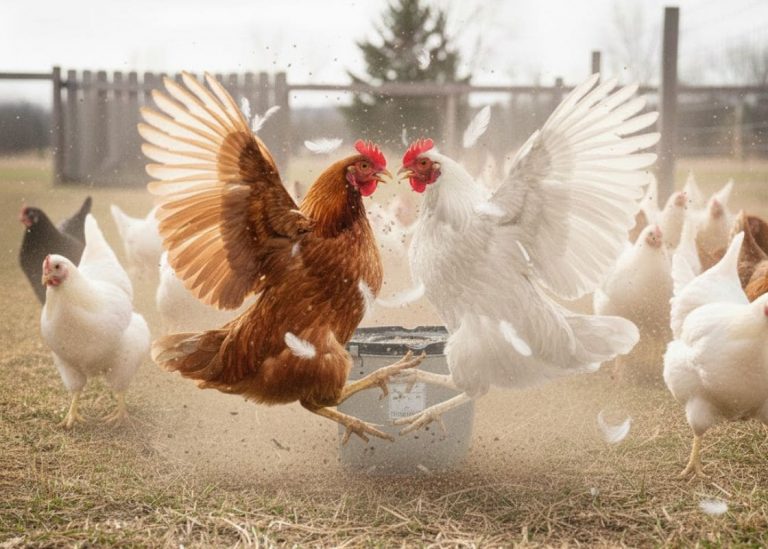
This coop is built for scale and function. It houses around 600 Leghorn chickens and stretches nearly 12 meters in length, with multiple doors, long walls, and a wide run that sees constant movement. Decorating it meant thinking beyond small touches.
I hung large wreaths along the length of the coop, spacing them evenly so the structure felt balanced.
When I stepped back to look, I felt a small disappointment settle in. The wreaths were nice, but the coop still looked unfinished, like it was wearing accessories without having a personality.
The Drive That Changed Everything
I got in the car and drove into town. I ended up at Walmart in Springfield, the large one with the seasonal section that always feels slightly overwhelming in December.
Inside, the Christmas displays were already in full force. Rows of lights, oversized ornaments, artificial trees, and decorations stacked higher than necessary.
I walked slowly, telling myself I was only looking, letting my mind wander toward the Leghorn coop as I moved. Then I saw it.
A large decorative sled, weathered-looking but sturdy, with a painted chicken standing proudly on top. It was oversized, cheerful, and just a little ridiculous in a way that made me smile immediately.
Nearby were heavy outdoor pots filled with winter flowers and hardy greenery, reds and deep greens meant to survive cold weather without fuss.
I checked the prices. The sled wasn’t cheap and the pots weren’t either. I stood there longer than I planned to, imagining them against the long wooden wall of the coop, imagining how they might break up the straight lines and bring warmth to a space built purely for utility.
In the end, I didn’t argue with myself. I loaded everything into the cart and drove home.
Bringing the Leghorn Coop to Life
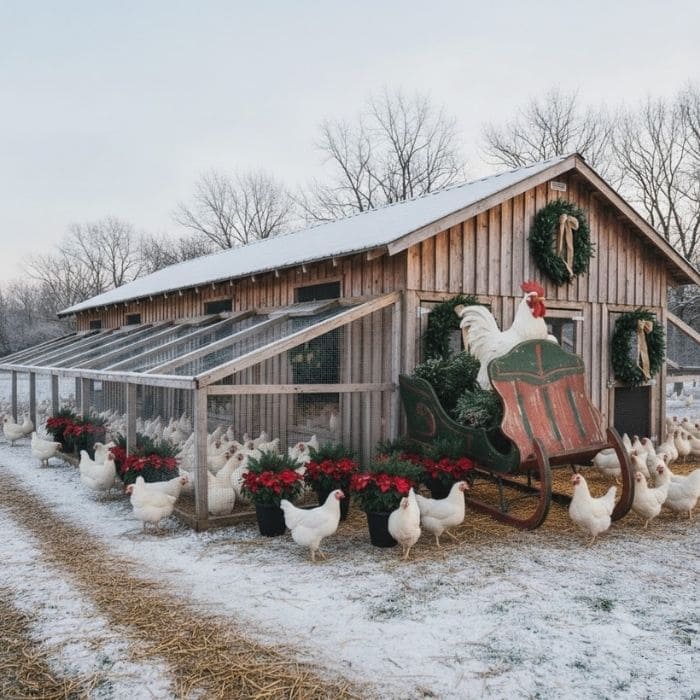
Back at the farm, I placed the sled near the main entrance of the Leghorn coop, angled slightly so it looked like it belonged there rather than being placed for effect. The painted chicken felt like a quiet joke shared between me and the space.
I arranged the pots of flowers along the length of the coop, using them to anchor the wreaths visually and add depth where winter usually flattens everything. I adjusted spacing, stepped back, moved things again, and let the layout settle naturally.
As the afternoon light softened, the coop changed. It didn’t become flashy or decorative in a loud way. It became warm. A place that felt acknowledged instead of purely functional.
The Leghorns moved through the space calmly, curious for a moment, then uninterested in the best possible way.
Standing Still at the End of the Day
By late afternoon, with the sun lowering and the air cooling quickly, I stood between the two coops and took it all in. The Sweater coop looked cozy and whimsical. The Leghorn coop looked steady, grounded, and quietly festive.